
The Strategic Importance of Skills in Modern HR and Business
Skills have moved from a Learning & Development specialty to a CEO priority. Leaders now treat skills as currency for competitive advantage – a shift reflecting fundamental changes in how organizations operate.
Work is increasingly organized around projects demanding specific capabilities, not predefined roles. Skills fit this logic naturally: they can be targeted, developed quickly, and deployed across organizational boundaries.
Traditional roles create silos. When tightly tied to departments, they limit cross-staffing and collaboration. Skills break these barriers. A skill is relevant across teams and contexts, making it easier to locate expertise and assign people to projects. A department may refuse to release a full-time role, but cannot deny that a person possesses a skill needed elsewhere.
This is why skills have become a shared organizational language. They enable agility, support collaboration, and allow companies to react precisely to shifting business demands. The conversation about skills is not a trend – it’s a response to how work fundamentally changes today.
Skills are the solution – and the problem
Organizations have invested heavily in Talent Management over two decades – frameworks, processes, technology. Yet most still lack a working skill ontology. The paradox: Talent is visible, but the underlying skills remain hidden.
Why? Talent Management focuses on holistic potential and internal career paths. It requires mature, integrated processes before delivering value. Skills, by contrast, are concrete and output-driven. This creates three practical advantages:
Speed: Skill Management can start small (MVP) and grow organically, rather than requiring fully integrated Performance Management, Learning, and Succession Planning upfront.
External leverage: Instead of analyzing internal career patterns, organizations can use vendor skill libraries and AI to derive skill sets from existing role descriptions.
Adaptability: Skill databases evolve continuously. Unlike static job families or grading systems, skills support temporary and highly specialized requirements.
But these advantages aren’t automatic. The core challenge lies beneath the surface: Organizations must understand their actual skill needs across different business contexts – and honestly assess whether today’s technology can support those needs.
Business leaders are hungry for skills. Technology is available. Employees will maintain skill data if they benefit. Yet most Skill Management initiatives underdeliver because they assume all skills are alike. They aren’t.
A CNC operator’s certification is not managed like a product manager’s negotiation skill. Cybersecurity expertise is not developed like leadership judgment. Production planning is not the same as R&D experimentation.
Different skills demand different approaches. Without understanding these differences, organizations risk building sophisticated skill databases that optimize the wrong things.
Two Dimensions to structure business demands on skills
Within the different business areas, with their different strategies, activities and future demands, expectations on how to identify, develop and leverage skills vary significantly. These differences can be structured along two dimensions:
The specification of the skills describes how universal or company-specific a skill is. In the following model, three different levels of specification are used:
Universal skills are generally required to perform broad business activities and are applicable across multiple roles. They strongly influence the employability and mobility of people across functions, organizations and even industries. Typical examples include negotiation skills, analytical skills, or the ability to lead people.
Specific skills are required to master defined activities and processes within particular business areas. Typical examples are the interpretation of G- and M-code for CNC machines, Ad Hoc Query Management in SAP HCM or Critical Path Management (CPM) for project management.
Mission critical skills are directly linked to the core business processes of an organization and determine whether strategic objectives are achieved or missed. In this context, mission critical does not describe the technical nature of a skill, but its business impact if unavailable or performed incorrectly.
The skill leveling type reflects that proficiency of a skill can be assessed in different ways. There is no single rating scale that fits for every context. In this model, three general leveling types are described:
Exact measurable skills can be examined, tested and assessed against clearly defined levels. They are typically validated through exams or certifications, and in some environments performing activities without such proof in not permitted. Examples include machine licenses (e.g. for CNC operation) or qualifications required for an Aircraft Maintenance License in avionics.
Contextual leveling means that the exact level of the skill is less relevant than the ability to apply and combine skills effectively in a specific situation to achieve an expected outcome. In such cases, it is difficult to define or measure a single skill because the context when using the skill is essential. For example, your negotiation skill may be effective for resolving a team conflict but insufficient when negotiating a complex client contract.
Dynamic and adaptive refers here to environments with high uncertainty, where skill relevance, depth and combinations change continuously. This goes beyond proficiency levels and focuses on the ability to adapt the skills to current or unknown future business challenges. That could occur in leadership situations when decisions are required under uncertainties, cross-functional projects, or research and development contexts where outcomes are not predictable.
In practice, business expectations towards skills are typically not expressed at single-skill level. They are usually articulated through roles, functions or responsibilities, which bundle and contextualize skills. Therefore, skills are discussed here as bundled capabilities in context, not as isolated data points.
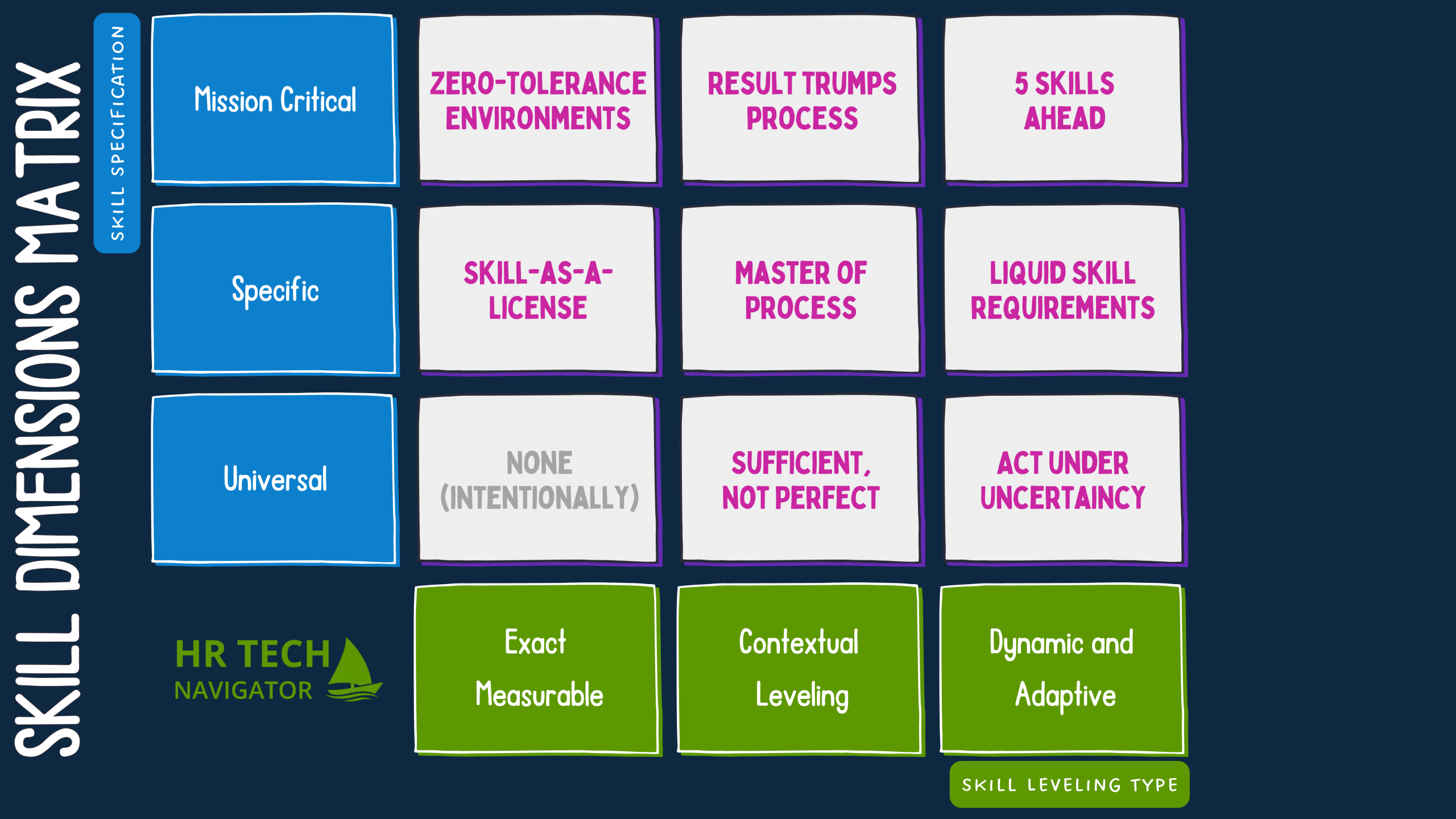
Combining skill specification and skill leveling type results in the following matrix:
Let´s go through every quadrant of the matrix to describe the essential differences in the skill demands of the business.
Zero-tolerance environments combine the dimensions of mission critical and exact measurable skills. This is typically the smallest skill pool in an organization, but one with the highest risk exposure. Traditionally, skills in this quadrant are linked to niche and highly regulated businesses operations in Nuclear Power Plants, aircraft maintenance or the aerospace industries, where the smallest mistake could lead to fatal consequences. Skills in these environments are rigorously trained, monitored, audited and re-validated. Every incident leads to an investigation to clarify whether insufficient skills contributed to the incident and whether existing trainings are still adequate. Managing these skills is time-intensive and costly, but often legally mandatory. Increasing digitalization and geopolitical developments let this quadrant expand in recent time: Skills related to cyber security, AI model validation, advanced data analytics & prediction and antifragile operating models are becoming mission-critical for the organization’s ability to operate safely and competitively.
Skill-as-a-license represents the intersection of specific skills and exact measurable leveling and typically forms the largest skill population in traditional production companies. This quadrant reflects the classical skill model with a clear role allocation. It is essential for running the operation of production sites in which qualifications to run specific machines are the foundation for production and workforce planning. Skills are usually tied to jobs and positions and have a mid- to long-term relevance for ongoing operations. Training, monitoring and auditing are established, but less intensive and rigorous than Zero-tolerance environments. Many traditional Talent Management and Skill Management concepts are following this logic, even for jobs and roles outside production areas.
The None-quadrant with the combination of universal but exact measurable skills is intentionally empty. Once a universal skill becomes exact measurable, it effectively turns into a specific skill. There are no meaningful roles defined by expectations such as: “We do not know which skill is required, but it must meet an exact level”.
Sufficient, not perfect are universal skills with a contextual leveling and relate to business environments where the expectation on role adequacy is more important than skill excellence. Success is achieved by combining the right skills in the right context rather than improving individual skill levels. Exact measurement is unnecessary, relative assessments are sufficient. Qualifications and trainings are typically linked to dedicated roles, and the associated skills are not exclusively relevant for one role but transferable across multiple functions. This quadrant covers most of the white-collar roles where tasks vary over time and new skills are required from time to time to remain effective in the role. The pool of skills in this quadrant is evolving over time, so continuous learning – formal and practical – is required to stay sufficient, but not perfect.
Master of process combines specific skills with contextual leveling and applies to roles responsible for specialized processes within defined organizational areas. In these environments exact skill levels are less important than the combination of the relevant qualifications and practical experience to deliver expected outcome reliably. This skill quadrant typically includes expert roles in Corporate Functions such as Payroll, Legal or Procurement. Developing skills requires investment and organizations usually aim to retain such experts in their roles for longer time due to limited availability of such skills on the labor market.
Result trumps process describes mission critical skills with contextual skill leveling. Skill expectations are deliberately fuzzy because business outcome matters more than defined skill depth. Targets are often clearly specified, while the skills and paths needed to achieve them remain unpredictable. This applies to areas such as Sales or Product Development, where success is measured against hard business KPIs like revenue or market impact. As a consequence, standardized development plans are difficult to define, and the individuals must actively identify and develop the skills that help them to progress – sometimes beyond their original functional area.
Act under uncertainty reflects universal skills with dynamic or adaptive skill levels. Such environments are characterized by frequent, unpredictable situations that require situational judgement rather than predefined responses. A broad toolbox of universal skills provides the foundation, but to master the emerging challenges applying the right skill at the right moment is needed. This skill quadrant is closely linked to leadership roles across management levels, where prioritization, decision-making and sense-making under uncertainty are expected. These capabilities develop over time through experience and reflection; training can expand the toolbox but cannot ensure effective application in critical moments.
Liquid skill requirements describe specific skills applied in dynamic or adaptive environments. Roles in this quadrant rely on defined processes and specialized skills, but the context in which they are applied changes continuously. As a result, skills need to be adapted to each situation. People working in such an environment require a strong ability to upskill themselves and adjust their capabilities over time. Training and qualifications provide a foundation, but concrete expectations emerge dynamically from the situations employees face. Typical examples include cross-functional projects, software development or business development.
5 skills ahead represents mission critical skills with dynamic or adaptive skill leveling, targeting on securing the current and future competitive advantages of the organization. Therefore, focus is on anticipating future skill needs rather than optimizing current ones. This quadrant is relevant for only a small number of people in the organization, often in strategic leadership or advanced R&D roles. They are required not only to develop relevant skills themselves, but also to identify which skills matter next – also for the entire organization. Traditional training and skill measurement approaches offer limited value in this context due to high level of uncertainty.
As illustrated by the skill dimensions matrix, business demands on skills are different and need different approaches in defining, measuring and managing skills. Functional concepts and supporting technologies need to consider this diversity to enable effective and company-wide Skill Management. And of course, resources and capacity are limited in companies, so it is essential to set top priority on the most important skill dimensions and not trying to solve all skill demands in one.
Employee Skill Transparency in Times of Change
Skill Management concepts naturally focus on business demands and on closing identified skill gaps. However, successful Skill Management also requires a deep understanding of employee needs and of their motivation to make their skills transparent.
From an employee perspective, different situations can be observed. In many cases, employees are aware of their skills and how these skills help them perform in their current role. It is therefore very likely that they want these skills to be visible within the organization, or at least to their direct manager.
Employees also know that their skills can support career progression. Making skills transparent becomes a way to position themselves within the organization and to signal readiness for new responsibilities, roles or development opportunities.
At the same time, some employees are fully aware of their skills but deliberately decide not to make them transparent. They may wait for a better moment to leverage these skills, either within the organization or outside of it.
Finally, there are situations in which employees are not fully aware of their own capabilities. In these cases, others in the organization may recognize these skills and use them, even if the skill-owner does not actively articulate them.
These different employee situations illustrate a central challenge for Skill Management. Skills are not neutral data points that employees automatically share with the organization. It either requires major support from the organization to detect “hidden” skills or employees need to make them transparent. Making skills transparent is a strategic decision influenced by trust, career expectations, perceived risks and personal goals.
If organizations want employees to actively contribute their skill data, Skill Management must offer clear and visible benefits from the employee’s perspective. Otherwise, skill transparency remains partial, selective or purely role driven. Understanding these motivations is therefore a prerequisite for designing Skill Management concepts that work in practice – not only for the business, but also for the people involved.
Finally, a set of external factors increasingly shapes how organizations demand, define and manage skills. These factors directly influence where skills are located within the skill dimensions model and explain why skill expectations move between different quadrants over time.:
- The growing importance of fluid workforce models and project-based work shifts skill demands away from stable, role-bound environments towards more dynamic and adaptive quadrants. Traditional concepts built around long-lasting and clearly defined roles within structured production processes are losing relevance.
- The global availability of skills reduces the importance of physical location for many skill categories. Once skills are clearly identified and described, they can often be sourced remotely, nearshore or offshore. This particularly affects universal and specific skills with contextual or dynamic leveling, which can be deployed flexibly across organizational and regional boundaries.
- Shorter innovation cycles and business lifecycles lead to more frequent movement of skills across the matrix. Skills that were previously specific and stable increasingly require dynamic adaptation, as business processes and technologies change faster than traditional development paths can follow.
- Rising business and technology complexity increases the time and effort required to build deep expertise. While skill requirements change faster, upskilling takes longer, pushing organizations to carefully balance exact measurable skills with contextual and adaptive skill expectations, especially in mission-critical areas
- The impact of AI on skill development and usage remains uncertain, but it is likely to reshape the matrix fundamentally. Some skills may rapidly lose relevance, while others move towards mission-critical status, often combined with higher demands for adaptability rather than exact proficiency levels.
- Geopolitical disruptions have immediate and severe effects on business operations and can abruptly change which skills become mission critical. In such situations, organizations must quickly reassess their skill portfolios and shift focus across quadrants to remain resilient and competitive.
Taken together, these external factors demonstrate that skills are not static assets. They continuously change their position within the skill dimensions model, reinforcing the need for flexible, context-aware Skill Management rather than rigid, one-size-fits-all approaches.
Why There Is No One Skill Management Platform
Over the last five years, the HR technology market has seen significant movement around Skill Management. Strategic investments of the established HR Tech vendors and venture capital have enabled a wave of start-ups to develop dedicated skill management solutions. These solutions have not only extended traditional approaches to managing skills but have also influenced how organizations think about Skill Management today. Many of the concepts currently discussed – such as opportunity marketplaces, gigs or skill-based task allocation – were primarily driven by technological capabilities rather than by a differentiated understanding of business skill demands.
This technology-driven development becomes problematic when the organization does not consider the skill dimensions model from above. The model illustrates that business expectations towards skills differ significantly across contexts – ranging from exact measurable, mission-critical skills to highly dynamic and adaptive capabilities. Nevertheless, many organizations approach the market in the opposite direction: instead of starting from their main pain points in the matrix, they are inspired by software demos and vendor showcases. In practice, organizations often search for solutions to problems which they are not yet aware of or which are not yet clearly defined, allowing technology to shape the concept rather than the other way around.
Looking more closely at the market, five distinct vendor logics can be identified. Each of them implicitly addresses only certain positions within the skill dimensions model and reflects a specific understanding of how skills should be defined, managed and leveraged.
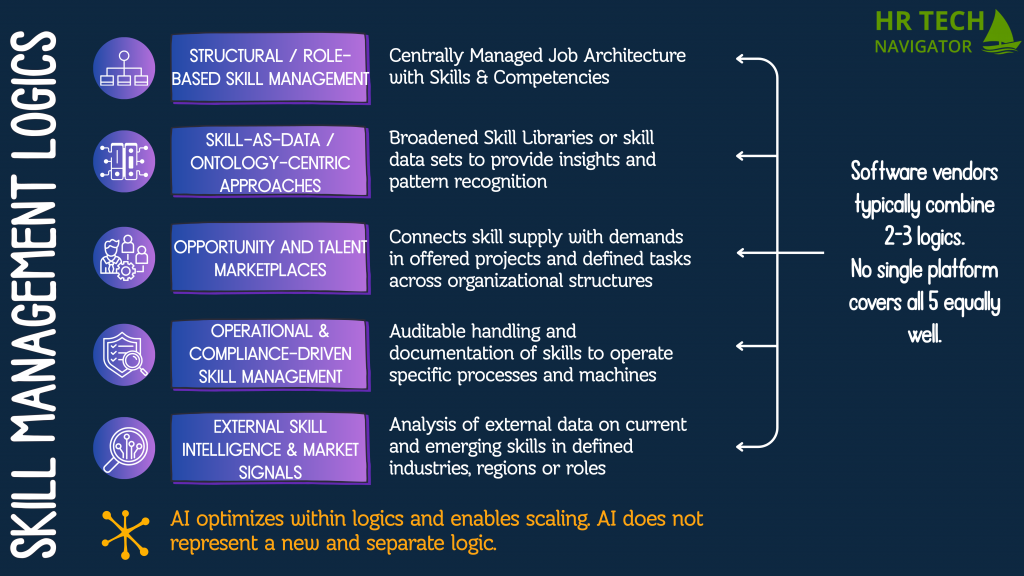
1. Structural / role-based skill management
One group of solutions follows a traditional, structural logic. These solutions drill down from job architectures through job families, roles and positions to skills and competencies. Within the skill dimensions model, this approach mainly supports quadrants characterized by specific skills and exact measurable leveling, as well as relatively stable environments. Its strength lies in predictability and control, enabling classical career paths, succession planning and skill-based operational planning, for example in production contexts. However, this logic struggles when skills move towards contextual or dynamic quadrants, where adaptability and situational application become more important than predefined structures.
2. Skill-as-data / ontology-centric approaches
A second group of solutions focuses primarily on skills as isolated data points. Whether implemented through predefined top-down skill ontologies or decentralized bottom-up models maintained by employees, the underlying assumption is that better data automatically leads to better decisions. This approach aligns technically well with universal or specific skills that can be described and compared at scale. From a skill dimensions perspective, however, it often underestimates context. Skills do not exist independently of people, roles and situations. Especially in quadrants with contextual leveling or dynamic adaptation, reducing skills to abstract data points neglects personal motivation, experience, preferences and cultural factors that strongly influence how skills are actually applied.
3. Opportunity and talent marketplaces
A third category is represented by opportunity marketplaces. These solutions are typically positioned as an answer to dynamic and fluid skill demands, aiming to connect skill supply with project-based or task-based demand. In terms of the skill dimensions model, they primarily target quadrants with contextual or dynamic leveling. At the same time, they often assume a high degree of skill mobility and employee willingness to apply skills flexibly across organizational boundaries. In practice, this assumption frequently clashes with traditional organizational structures, leadership models and incentive systems. Opportunity marketplaces therefore face the risk of underestimating required change management efforts: employees may make their skills visible, while leaders continue to allocate work based on roles, teams and headcount rather than on individual skills. With opportunity markets a new skill culture is needed in the organization.
4. Operational and compliance-driven skill management
Beyond HR-centric concepts, a further solution logic focuses on operational execution and compliance. These solutions originate from production, service management or workforce deployment contexts and manage skills primarily as prerequisites for safe, efficient and compliant operations. Within the skill dimensions model, this logic strongly supports quadrants with exact measurable and mission-critical skills, as well as specific skills with stable or semi-stable requirements. Development aspects are secondary; the primary objective is to ensure that the right, certified skills are available at the right time.
5. External skill intelligence and market signals
A fifth solution logic extends beyond the organizational boundary. These solutions analyze external labor market data to identify emerging skills, declining capabilities and long-term trends. Rather than managing skills operationally, they provide strategic intelligence to inform workforce planning, build-or-buy decisions and the identification of future mission-critical skills. In the skill dimensions model, this logic mainly addresses dynamic and future-oriented quadrants, such as “5 skills ahead”, without offering direct mechanisms for internal skill deployment.
Of course, the solutions offered today do not represent one pure logic but cover several of the logics in one platform. However, no solution can cover all logics and all skill dimensions. Companies need to decide, which kind of skill management is most important for them.
Finally, the role of AI needs to be considered in relation to the skill dimensions. AI acts as an accelerator across all skill management and vendor approaches. It can translate job descriptions into skill libraries, detect patterns in skill data, recommend related skills or profiles and improve matching mechanisms in opportunity marketplaces. With the capabilities of AI, the vendors are able to process the sheer amount of skills into an ontology framework which is scalable and efficient. However, AI does not resolve the fundamental challenge illustrated by the skill dimensions model. If Skill Management approaches remain focused on isolated data points or single quadrants, AI will only optimize within these limitations. Without a holistic understanding of how different skill expectations coexist and shift across the matrix, AI remains an enabler of efficiency, not a driver of effective Skill Management.
Creating Clarity in Skill Management Decisions
The market does not offer a single Skill Management platform. Instead, vendors specialize in different skill dimensions and management logics. Some excel at operational compliance and exact measurable skills. Others focus on dynamic, project-based skill deployment. No platform covers all five logics equally well.
Selecting the right tool starts with clarity: Which skill dimensions matter most? Where are the biggest gaps? Trying to cover all nine quadrants equally leads to high effort, fragmented implementations and underutilized platforms. Organizations must prioritize—whether that’s production compliance, cross-functional mobility, or future-critical capabilities—and select technology aligned with those priorities.
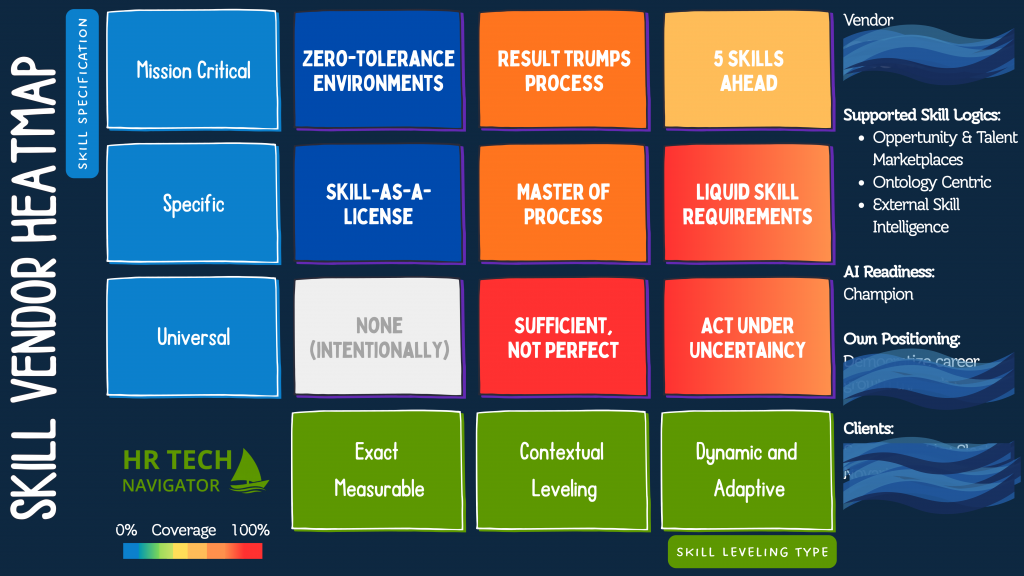
The HR Tech Navigator coaching framework helps organizations map their challenges to the skill dimensions matrix and identify fitting solutions. A core tool is the Skill Vendor Heatmap, which shows:
- Which vendors cover which quadrants (e.g., compliance vs. mobility)
- Supported skill management logics (structural, marketplace, operational, etc.)
- AI maturity and positioning
- Reference clients and use cases
However, effective Skill Management does not start – or end – with reading another vendor comparison or assessment report. The real work lies in building a shared understanding of skill priorities across Top Management, Business Leaders, HR and HR IT, aligning them with organizational context, and translating them into a coherent technology and operating model.
The HR Tech Navigator helps organizations gain clarity on their skill challenges, guides them through vendor selection and implementation, and supports the creation of tangible impact through a Skill Management approach that fits both business demands and organizational reality.
Sources:
Gloat in collaboration with David Green & Udemy business, 2023: The ultimate guide to the skill-based organization
Mihnea Moldoveanu, Kevin Frey, and Bob Moritz in Havard Business Review, 2022: 4 Ways to Bridge the Global Skill Gap
Ingo Müller, Martin Wild, 2007: Mitarbeiterförderung und -bindung im Rahmen von Talent Management, Ein praxisorientiertes Konzept für die UBS AG
OECD (2025), Empowering the Workforce in the Context of a Skills-First Approach, OECD Skills Studies, OECD Publishing, Paris
Eliezer Yudkowsky, Nate Soares, 2025: If anyone builds it, everyone dies. Why Superhuman AI would kill us all
Want to map your skill challenges to the right technology?
Contact HR Tech Navigator for:
✓ Skill Dimensions Assessment Workshop
✓ Vendor Heatmap Analysis
✓ Implementation Roadmap Consulting
martin.wild@hrtechnavigator.com
hrtechnavigator.com